

What Should a Fashion Portfolio Include?
A weak portfolio usually fails for one simple reason: it shows effort, but not direction. If you are asking what should a fashion portfolio include, the better question is what a portfolio needs to prove. It should prove your point of view, your technical ability, your creative process, and your potential in a specific area of fashion.
That matters whether you are applying to a fashion school, preparing for an internship, changing careers, or presenting yourself as a freelance creative. A portfolio is not a scrapbook of everything you have made. It is a selective, strategic edit of work that tells people where you fit in the industry and why they should take you seriously.
What should a fashion portfolio include for a strong first impression?
The best portfolios feel focused from the first few pages. They do not overwhelm the viewer with random sketches, disconnected photos, or unfinished ideas. Instead, they create a clear narrative. Even if you are still a beginner, your portfolio should show intention.
In most cases, a strong fashion portfolio includes an introduction, a curated selection of projects, process work, final outcomes, and a presentation style that feels professional. If you are applying for a design-focused role, that mix will lean more heavily into research, moodboards, fabric direction, silhouettes, technical development, and collections. If you are aiming for styling, communication, branding, or content creation, the balance changes. The principle stays the same: show relevant work, not just attractive work.
A portfolio should also reflect your level honestly. Trying to look overly advanced can backfire. If you are at the beginning of your fashion journey, it is better to present strong fundamentals and a clear eye than to imitate high-level industry work badly. Clarity is more convincing than exaggeration.
Start with your identity as a creative
Your opening section should establish who you are. This does not need to be long or dramatic. A short profile with your name, discipline, and creative focus is enough. You can include a brief statement about your interests such as womenswear design, streetwear, sustainable fashion, image-making, styling, or trend research.
This section helps the viewer understand how to read the rest of your work. Without it, even good projects can feel disconnected. A fashion portfolio is stronger when the selection supports a recognizable direction.
If you work across multiple areas, be careful. Range is useful, but too much variety can dilute your message. For example, combining styling editorials, couture sketches, logo design, and social media mockups in one portfolio may confuse the viewer unless there is a reason behind it. If you have broad interests, group the work carefully and make your focus clear.
Show complete projects, not isolated pages
One of the most common mistakes is presenting only final illustrations or polished images without showing how the idea developed. In fashion, the process matters. Schools, recruiters, and clients want to understand how you think, not just whether you can make a page look good.
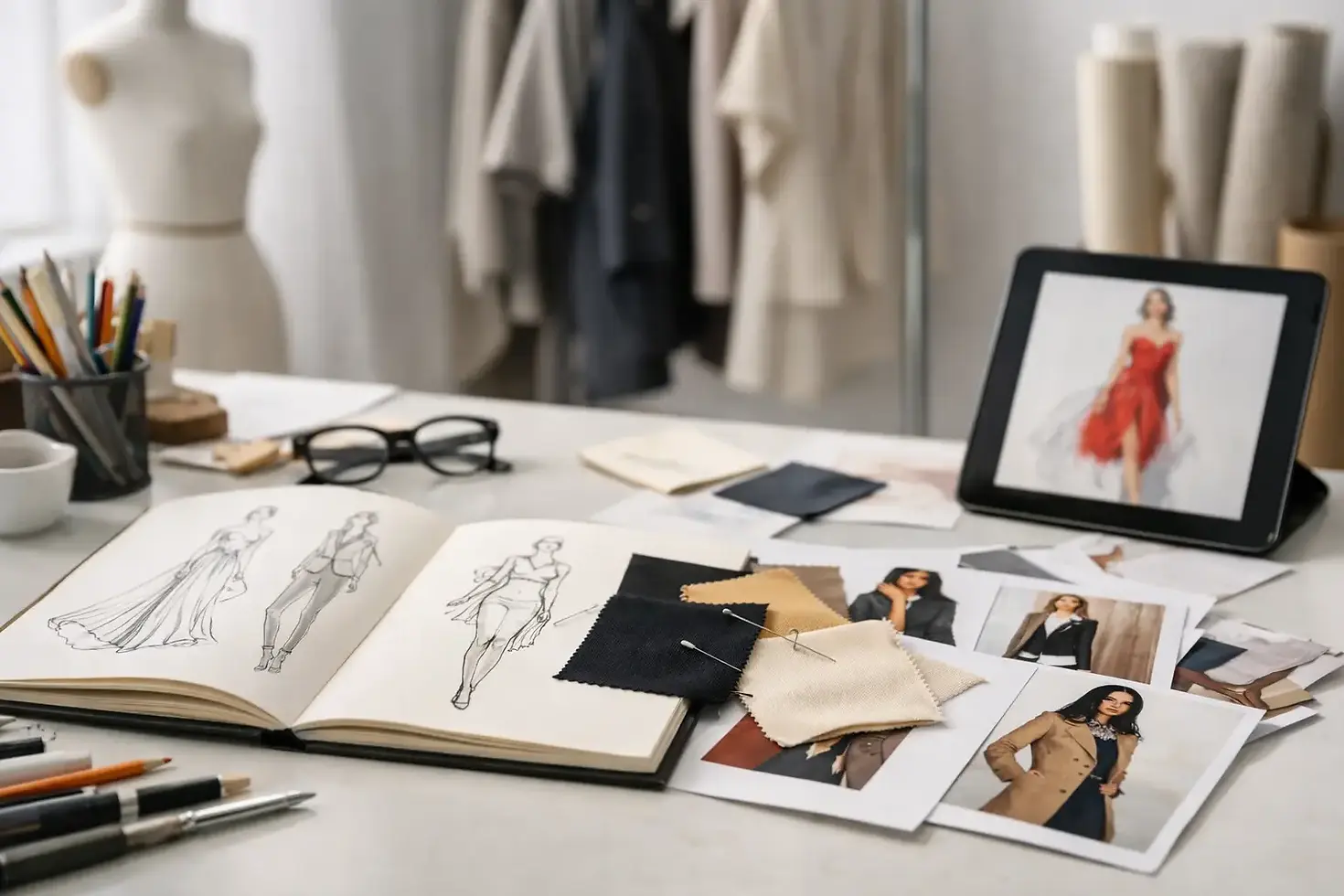
A strong project usually includes concept research, inspiration, color direction, silhouette development, material or fabric ideas, experimentation, and final outcomes. For designers, this may mean moodboards, croquis, technical flats, collection pages, textile ideas, and key looks. For stylists, it may include concept boards, visual references, pull selections, shoot direction, and final editorial images.
The exact format depends on your path, but each project should feel complete. A viewer should be able to move from the initial concept to the finished result without guessing what happened in between.
This is where many portfolios become more persuasive. Final outcomes are important, but process pages often reveal originality, discipline, and problem-solving. Those qualities matter in professional fashion environments.
Include research that shows visual intelligence
Research pages are not filler. Done well, they demonstrate your ability to observe, interpret, and build a concept. In fashion, inspiration is part of the work. The key is to make research look intentional rather than decorative.
Avoid collecting random images with no connection. Instead, build research around a theme, an era, a cultural reference, a material story, a social idea, or a market direction. Explain the logic through captions, short notes, or visual sequencing. Show how your references influenced shape, proportion, texture, styling, or color.
If you are preparing a portfolio for study or early career opportunities, this section can make a major difference. It shows that you are not only reacting to trends but learning how to build a creative direction from source material.
Include sketches, development, and technical thinking
If you want to work in fashion design, your portfolio should not stop at beautiful illustrations. Drawing skills are useful, but fashion is also construction, proportion, function, and coherence across a collection.
This means your portfolio should include development sketches, garment ideas, lineups, fabric considerations, and technical flats when appropriate. Even if your technical level is still growing, showing that you understand the transition from concept to product makes your work more credible.
There is a trade-off here. Too much technical detail can make a portfolio heavy, especially for creative admissions or image-led roles. Too little can make it seem superficial. The right balance depends on where you are applying. A design school may want more process and development. A stylistic or visual role may care more about image direction and final communication. Tailoring the portfolio is not optional. It is part of presenting yourself professionally.
Use final images that feel resolved
Every portfolio needs moments of impact. Those usually come from final outcomes: finished garments, styled shoots, editorial pages, lookbooks, digital renderings, or polished collection boards. These pages show your taste level and your ability to bring ideas to a finished stage.
Quality matters more than quantity. Five strong final images are better than fifteen average ones. If your work has been photographed, choose clean, well-lit images that let the clothing or styling speak clearly. If the work is digital, keep the presentation sharp and consistent.
Avoid including final outcomes that are visibly weaker just to make the portfolio longer. Editing is part of being a creative professional. A concise portfolio with strong decisions is often more memorable than a long one with uneven quality.
Presentation matters more than many students expect
A good portfolio can lose impact if the layout feels messy. In fashion, presentation is never separate from content. The way you organize work says something about your visual discipline.
Keep fonts simple. Give images space. Use alignment consistently. Make sure pages are readable and not overloaded with effects. If every page uses a different style, the portfolio can feel unsure of itself. Consistency creates confidence.
At the same time, do not make it so minimal that it loses personality. Your presentation should support your work, not flatten it. Think of the layout as part of your visual language.
Digital portfolios should also be easy to open and navigate. A PDF is still one of the most practical formats because it keeps structure under control. If you are presenting online, the same rule applies: make it simple for the viewer to understand your work quickly.
What should a fashion portfolio include if you are a beginner?
Beginners often worry that they do not have enough work. In reality, a portfolio does not need professional projects to be effective. It needs evidence of potential.
If you are just starting, include personal design projects, styling concepts, sketchbook development, fashion illustrations, creative research, reconstructed garments, upcycling experiments, or self-directed briefs. A well-developed personal project is far more useful than a rushed attempt to imitate a brand campaign.
What matters is that the work shows curiosity, consistency, and some level of progress. Many schools and entry-level opportunities are not expecting perfection. They are looking for trainable talent, visual awareness, and commitment.
This is one reason portfolio-building works best when it is guided by industry standards. At Milan Fashion Campus, for example, portfolio development is approached as practical preparation for real opportunities, not as a decorative exercise. That mindset helps students understand what to include and what to leave out.
Tailor the portfolio to the opportunity
There is no single portfolio that works for every purpose. The version you send to a fashion design course should not be identical to the one you use for a styling internship or a personal brand presentation.
A school may want to see experimentation and development. A recruiter may want faster proof of relevant skills. A client may care most about final results and visual identity. If you keep one master portfolio, that is useful, but always edit the selection before sending it out.
This extra step makes a real difference. It shows that you understand the role, respect the viewer's time, and know how to position yourself.
What to leave out
A strong portfolio is defined as much by what it excludes as by what it includes. Leave out repetitive pages, unfinished work that adds no insight, copied concepts, weak photography, and projects that do not match your current direction.
You should also avoid overexplaining every page. Brief notes can help, but the work should mostly speak for itself. If a project needs a long paragraph to become interesting, the problem is usually the project, not the caption.
The goal is not to prove that you have done a lot. The goal is to prove that you are ready for the next step.
A fashion portfolio should feel like a professional conversation before you ever enter the room. Make it clear, make it selective, and make sure every page earns its place.


Comments