

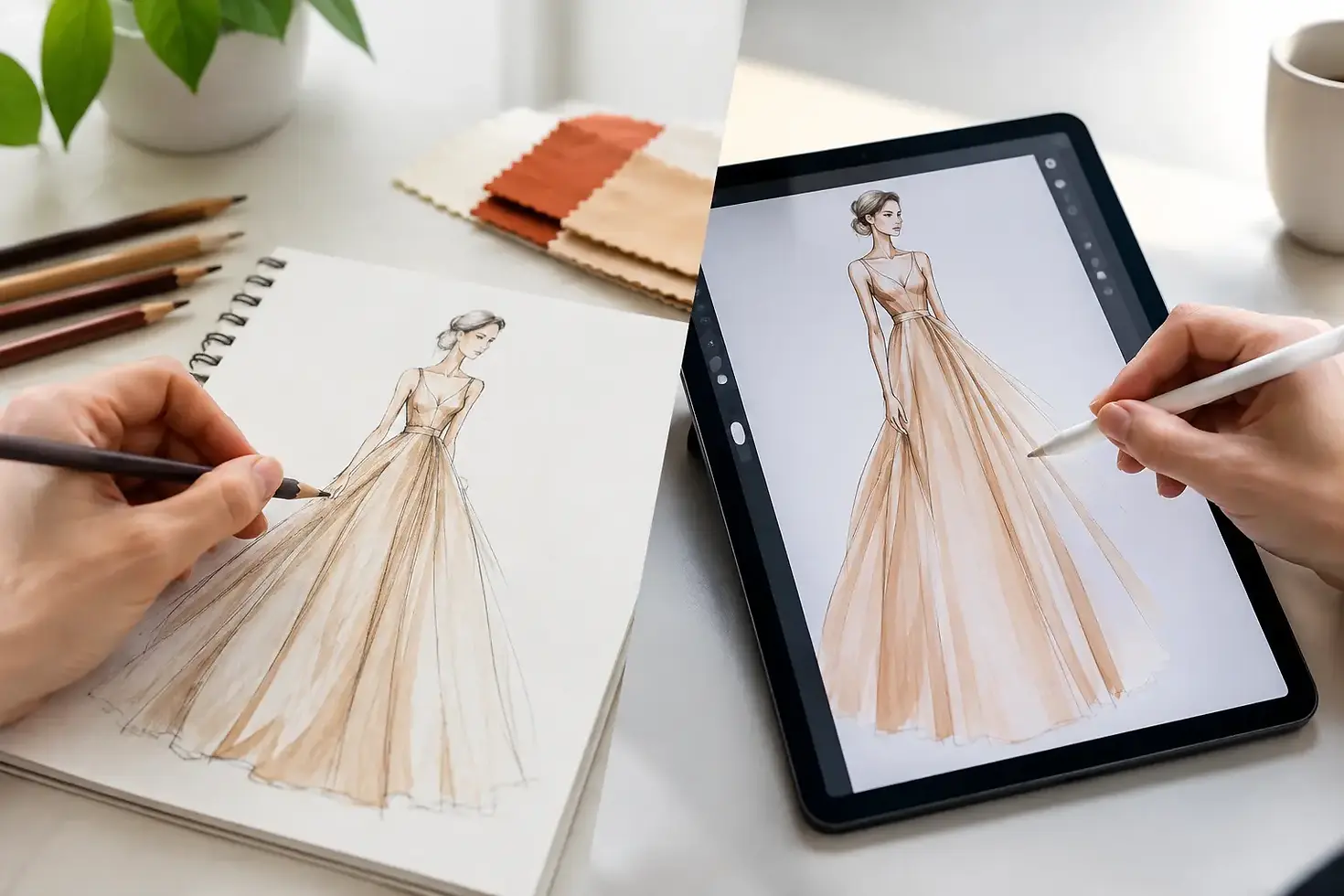
Fashion Illustration Versus Digital Sketching
A designer has five minutes before a fitting, a fabric supplier is waiting for color direction, and a client needs to understand a collection mood. This is where fashion illustration versus digital sketching becomes more than a question of personal style. It becomes a question of communication: what do you need the image to do, who needs to understand it, and how quickly must you revise it?
For aspiring designers, stylists, and portfolio builders, both skills are valuable. They are not competing paths. Fashion illustration develops your eye, your visual voice, and your ability to tell a story through the figure. Digital sketching gives you speed, flexibility, and a workflow that fits contemporary design teams. The strongest emerging professionals understand when to use each one.
Fashion Illustration Versus Digital Sketching: The Real Difference
Fashion illustration is the visual interpretation of fashion through drawing. It can be created with pencil, marker, watercolor, collage, ink, or digital tools, but its purpose is expressive communication. A fashion illustration may exaggerate proportion, lengthen the body, simplify a face, or use energetic marks to make a garment feel dramatic. It communicates an attitude as much as an outfit.
Digital sketching is usually more process-driven. Created on a tablet or computer, it often focuses on developing, testing, and presenting design ideas efficiently. A digital sketch can be loose and expressive, but it may also become a clean technical-looking flat, a color variation, or a revised version of an earlier concept.
The key distinction is not simply paper versus screen. Fashion illustration asks, “What should this fashion idea feel like?” Digital sketching often asks, “How can this idea be developed, adjusted, and shared?” In professional practice, one image can do both jobs. The difference depends on your intention and level of finish.
What Fashion Illustration Builds
Fashion illustration trains visual judgment. When you work by hand, you learn to observe how a jacket sits on the shoulder, where a wide trouser changes the figure’s balance, and how the weight of a fabric affects movement. You cannot rely on an undo button, so you make decisions, assess them, and improve through repetition.
This process is especially useful for beginners. A student who can sketch a figure, establish proportion, and suggest volume with a few purposeful marks has a foundation that transfers to every digital tool later. Hand drawing also helps designers create a recognizable voice. One illustrator may use elegant, minimal lines; another may build rich texture with paint. Both can communicate fashion convincingly because their choices are intentional.
Illustration is particularly effective when a collection needs emotion. Think of an editorial concept, a luxury eveningwear proposal, a styling story, or a portfolio page that introduces a point of view. A polished illustration can make the viewer pause. It gives a collection personality before a sample has been produced.
The limits of an illustration-led workflow
Hand-rendered work can be slower to revise. If a buyer asks to change a sleeve shape, a color palette, or a print placement, you may need to redraw significant areas. It can also be difficult to create exact consistency across many looks when a collection requires multiple versions of the same silhouette.
That does not make traditional illustration less professional. It simply means it is best used where expression, concept, and material sensitivity matter most. The most effective illustrators know when a beautiful drawing needs to be supported by clearer design information.
What Digital Sketching Makes Possible
Digital sketching supports the pace of modern fashion work. You can duplicate a base figure, test ten colorways, move a pocket, resize a print, or compare two silhouettes without starting again. Layers allow you to separate the body, garment, shading, accessories, and background, making changes faster and more controlled.
This is useful at every stage of a project. During research, digital sketching can help you collect visual references and rapidly test directions. During design development, it helps you build variations without losing the original idea. For presentations, it creates clean pages that are easy to organize and export for a portfolio or collaborative review.
Digital tools also support precision. You can work with repeated motifs, crisp seams, accurate color palettes, and scalable details. For students preparing for internships or creative roles, this ability signals that you can participate in a workflow where feedback is continuous and deadlines are real.
The risks of working only digitally
Digital tools can make a beginner look polished before they have developed design judgment. A smooth brush, a ready-made figure template, or a visually impressive effect cannot replace understanding of proportion, construction, fabric, or styling. If every drawing relies on the same preset pose and rendering method, a portfolio may feel generic.
There is also a temptation to refine too early. Designers can spend hours perfecting a sketch that should have remained a quick experiment. Early-stage work should generate options, not force every first idea into a finished result. Use digital speed to explore more freely, not to become overly cautious.
Which Skill Should You Learn First?
If you are a complete beginner, start by strengthening basic fashion drawing skills while introducing digital tools early. You do not need to wait until your hand drawings are perfect before opening a tablet app. In fact, moving between the two methods can accelerate learning.
Begin with the figure, silhouette, garment proportion, and simple fabric indication. Then use digital sketching to revise those ideas, apply color, and create variations. This sequence teaches both observation and efficiency. You learn why a design works before deciding how to polish it.
For career changers or working professionals with limited time, the priority may be different. If your immediate goal is to present product ideas, develop a small brand concept, or create social content with a consistent visual identity, digital sketching may give faster practical results. Still, schedule regular hand-sketching practice. It keeps your visual thinking active and prevents your work from becoming dependent on templates.
Choosing the Right Method for the Task
The best method depends on the outcome you need. Use fashion illustration when you are setting a mood, presenting a creative concept, showing styling personality, or building a portfolio spread that needs emotional impact. Use digital sketching when you need color options, clean revisions, repeated formats, clear presentation files, or rapid feedback from others.
A fashion design portfolio should normally show both. Include expressive work that proves you have an eye, then include development pages that reveal your thinking. Show early sketches, silhouette changes, color experiments, and selected final looks. This gives reviewers more confidence than a portfolio of only finished images because it shows how you make decisions.
For a designer, the most convincing page might start with a hand-drawn silhouette that captures the collection’s energy. It can then move into digitally developed versions with color, fabric notes, and alternative details. The combination feels creative and credible.
Build a Workflow That Uses Both
Many designers begin away from the screen. A sketchbook is immediate, low-pressure, and easy to use during research, travel, museum visits, or fittings. Quick hand sketches preserve ideas before they disappear. They also make it easier to explore imperfect possibilities without worrying about presentation.
The next stage can happen digitally. Photograph or scan your favorite sketches, place them in a digital workspace, and develop the strongest concepts. Refine the line, test color, add texture, or create different versions for a capsule collection. Keep your original sketch visible on a separate layer so the energy of the first idea is not lost.
Finally, decide what level of information the viewer needs. A creative director may want an expressive illustration that sells a direction. A patternmaker needs clarity about seams, closures, and proportion. A social media audience may respond to a strong visual moment. One design can be communicated in several ways without changing its identity.
How to Make Your Work Portfolio-Ready
A strong portfolio does not need hundreds of drawings. It needs evidence of ability, curiosity, and development. Choose work that shows range while still feeling connected to your personal point of view. Include both hand and digital work when it serves the project, not because you feel required to demonstrate every software feature.
Pay attention to presentation. Use clear page hierarchy, leave space around your work, and make sure color is consistent from page to page. When adding notes, write only what moves the idea forward: fabric intention, silhouette rationale, customer profile, or construction detail. Let the images lead, but give the viewer enough context to understand your decisions.
In intensive fashion education, this is where feedback matters. A tutor can often see whether a drawing needs more freedom, more accuracy, or a clearer purpose. At Milan Fashion Campus, students can build these skills through practical fashion illustration and digital design work shaped around portfolio development and real fashion communication.
Your next sketch does not have to choose a side. Draw the idea that feels urgent, then use the method that helps it travel further. The habit of moving from intuition to development is one of the most useful creative disciplines you can build.


Comments