

Color Analysis Training in Milan: What Every Future Personal Stylist Should Learn

Color Analysis Training in Milan
Quick Answer: How Can You Learn Color Analysis Professionally?
Color analysis training teaches future personal stylists how to evaluate the relationship between skin tone, hair, eyes, contrast, and clothing colors. Professional training combines color theory with practical styling decisions. In Milan, color analysis can be studied as part of a broader fashion styling course.
What Is Color Analysis Training?

Color analysis, known in Italy as armocromia, is a method used in personal styling and image consulting to explore how different colors interact with a person's natural coloring.
Its purpose is not simply to place clients into seasonal categories. Professional color analysis helps stylists understand why certain shades may create a more harmonious visual effect, how color affects the balance of an outfit, and how to translate those observations into useful wardrobe recommendations.
A good color analyst does more than identify a palette. They explain their observations, compare alternatives, understand personal preferences, and help clients apply color to real situations.
For future fashion professionals, this requires observation, practical exercises, fashion knowledge, and the ability to communicate recommendations clearly.
What Should You Learn in a Professional Color Analysis Course?

1. Understanding Color Temperature
The first foundation is distinguishing between warm, cool, and relatively neutral color characteristics.
Color temperature describes the visual relationship between hues. Warm colors often contain more yellow or orange influence, while cool colors tend toward blue.
A trained stylist learns to compare colors rather than assume that every person fits a perfectly defined warm or cool category.
The goal is to observe how different colors behave next to the face and which combinations support the client's desired appearance.
2. Recognizing Lightness and Depth
Color analysis involves more than temperature.
Lightness, sometimes called value, describes how light or dark a color appears.
Consider the differences between pale blue, medium denim blue, and deep navy. They may belong to the same broad color family, but they produce very different effects in an outfit.
Stylists need to understand how light and dark colors influence visual balance and how to select shades that work with an individual's natural coloring and personal style.
3. Understanding Chroma and Intensity
Chroma describes the strength or purity of a color.
A vibrant cobalt blue and a muted dusty blue can communicate entirely different aesthetics.
Bright colors may create visual energy, while muted shades often produce a softer impression.
The important skill is learning to evaluate these characteristics without assuming that one color intensity is universally better.
4. Working With Seasonal Color Palettes
Many color analysis systems organize palettes into four traditional seasonal families:
Spring: traditionally associated with warm, light or clear characteristics.
Summer: traditionally associated with cool and softer characteristics.
Autumn: traditionally associated with warm, rich or muted characteristics.
Winter: traditionally associated with cool, clear or high-contrast characteristics.
Some training methods expand these categories into 12 or 16 seasonal groups.
These systems can provide a useful framework for organizing color recommendations, but they are not objective biological classifications.
Professional stylists should use them as practical guidance rather than inflexible rules.
5. Evaluating Contrast
Contrast is another important element in personal color analysis.
A person with a strong difference between hair color and skin tone may respond differently to high-contrast outfits than someone whose natural coloring has softer transitions.
Stylists can explore contrast through combinations such as black and white, navy and cream, or tonal outfits using several shades of one color.
Understanding contrast also helps when choosing prints, accessories, eyewear, and statement pieces.
How Does a Professional Color Analysis Consultation Work?
A practical consultation can follow five stages.
Step 1 — Client Discovery
Understand the client's lifestyle, preferences, wardrobe, professional environment, and personal image objectives.
Step 2 — Color Observation
Compare carefully selected colors near the face, ideally under consistent, neutral lighting, while minimizing the influence of colored reflections and heavy makeup.
Step 3 — Palette Development
Identify a practical selection of colors, including neutrals, accent shades, and versatile combinations.
Step 4 — Outfit Application
Translate the selected palette into clothing, accessories, prints, and combinations appropriate for the client's wardrobe.
Step 5 — Personal Recommendations
Explain the color choices and provide realistic guidance that respects the client's taste, budget, identity, and existing clothes.
An effective analysis should give clients more options and greater understanding, not make them feel prohibited from wearing colors they love.
Practical Example: From Color Analysis to a Complete Outfit
Imagine a client who wants to develop a more professional wardrobe.
During the consultation, the stylist discovers that the client prefers contemporary tailoring, neutral colors, and minimal accessories.
Rather than immediately assigning a season, the stylist compares different shirt, jacket, and accessory colors.
A deep navy jacket might be compared with charcoal, warm brown, and several shades of grey. Different whites and creams can be tested near the face.
The stylist then considers the client's preferences, office environment, existing wardrobe, and desired image.
The result could be a coordinated selection of work outfits combining several suitable neutrals with carefully chosen accent colors.
This demonstrates the real value of professional color analysis: the ability to move from observation to practical wardrobe decisions.

Color Analysis Training: Online or in Milan?
Learning Option | Main Advantage | Best For |
Independent study | Flexible introduction to color terminology and theory | Beginners exploring the subject |
Online fashion styling course | Structured lessons, visual exercises, and practical applications | International students and career changers |
In-person fashion styling course | Direct observation, interactive exercises, and instructor guidance | Students seeking practical classroom experience |
The most appropriate option depends on your objective.
Someone interested in improving their personal wardrobe may begin with introductory learning.
Someone planning to work professionally should look for structured exercises, opportunities to develop consultation skills, and feedback on practical styling decisions.
Why Study Color Analysis and Fashion Styling in Milan?
Milan offers an educational environment where color can be explored as part of a broader fashion language.
Italian fashion education traditionally places strong emphasis on the relationship between clothing, silhouette, materials, accessories, and personal presentation.
For aspiring personal stylists, this wider perspective is important.
Color analysis should not exist separately from fashion knowledge. A beautiful palette becomes more valuable when a stylist understands how to use it with fabrics, textures, prints, tailoring, and contemporary clothing.
Studying in Milan also provides opportunities to observe retail presentations, designer collections, fashion exhibitions, and everyday street style.
At Milan Fashion Campus, international students can study personal fashion styling through intensive short courses that start every Monday.
This flexible approach allows students to choose a training period that fits their schedule instead of waiting for a traditional academic semester.
Courses are available in English or Italian.
Learning Color Analysis at Milan Fashion Campus
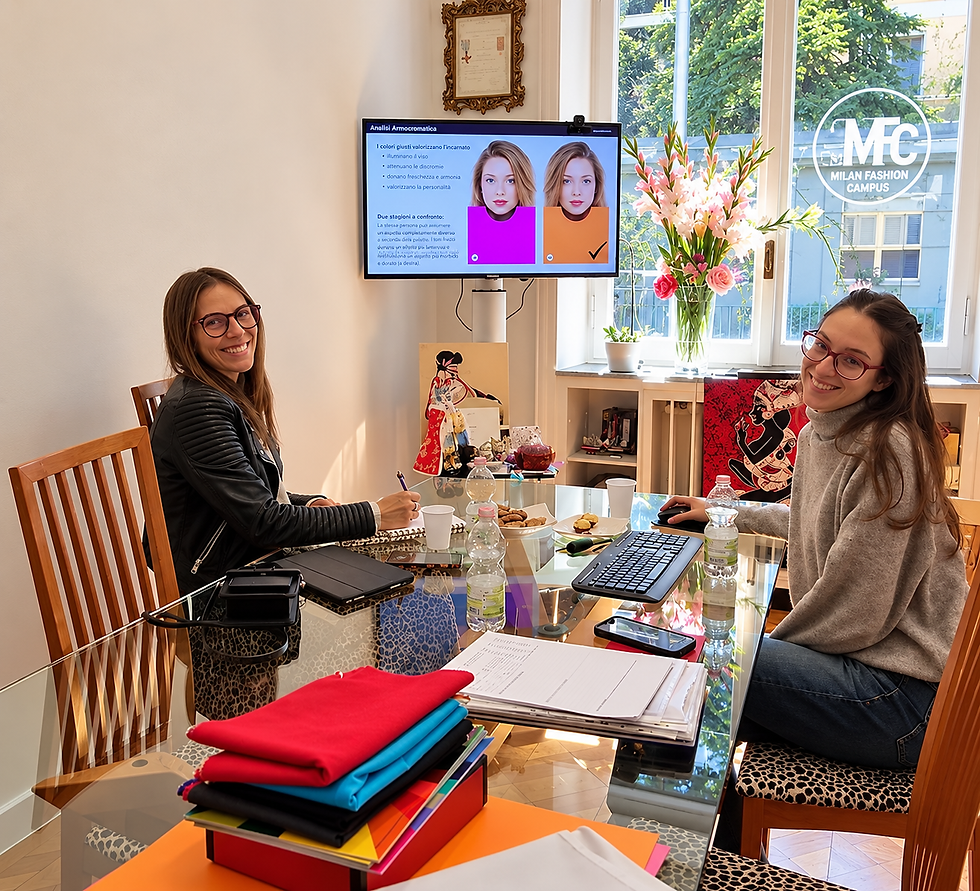
At Milan Fashion Campus, color analysis forms part of the Women's Personal Fashion Styling curriculum.
Students explore how clothing works in relation to an individual, including:
Color analysis and color coordination.
Body shape and face shape analysis.
Fashion styles and personal image.
Garments and accessories for different clients.
Outfit combinations and styling presentations.
Visual research and moodboard development.
The aim is to develop an integrated understanding of personal styling rather than studying color as an isolated technique.
Students who prefer learning remotely can explore the online Women's Fashion Styling Course, which also includes color analysis and practical styling exercises.
For those who already possess styling knowledge and want to develop their professional services, Milan Fashion Campus also offers Start Working as a Personal Stylist, an online program focused on clients, services, positioning, pricing, and freelance activity.
This business-oriented course complements technical styling education rather than replacing it.
Can Color Analysis Help You Become a Personal Stylist?
Yes. Color analysis can be a valuable skill within a wider personal styling service.
Professional stylists may use color knowledge during wardrobe consultations, personal shopping appointments, image consulting, and outfit planning.
For example, a client may request help building a capsule wardrobe with colors that coordinate easily.
Another may want to understand which makeup or accessory shades work with their clothing choices.
Color analysis provides a structured starting point for these conversations.
However, becoming a competent personal stylist also requires knowledge of garment proportions, personal style, fashion products, client communication, and wardrobe organization.
Learning color analysis is therefore an important part of training, not a complete substitute for it.
Frequently Asked Questions About Color Analysis Training
1. Can beginners learn color analysis?
Yes. Beginners can start with color theory, temperature, lightness, intensity, and contrast before developing more advanced practical skills.
2. How long does it take to learn color analysis?
Basic principles can be introduced through short courses or individual modules. Developing reliable consultation skills requires additional practice and experience with different clients.
3. Can I become a color analyst through an online course?
Online courses can teach color theory and structured analysis techniques. Practical experience is important, particularly because screens, cameras, and lighting can affect how colors appear.
4. Is color analysis the same as personal styling?
No. Color analysis focuses on evaluating and coordinating colors. Personal styling also involves clothing, proportions, lifestyle, accessories, occasions, and the client's overall image.
5. Do I need a certificate to work as a color analyst?
Requirements depend on the country and the services offered. A course certificate can document completed training, but it does not automatically represent a government-recognized professional license.
6. Is seasonal color analysis always accurate?
Seasonal systems offer useful organizational methods but have limitations. Results can vary depending on the system, lighting, evaluator, and subjective interpretation.
7. Can I study color analysis in Milan in English?
Yes. Milan Fashion Campus offers English-language personal fashion styling courses that include color analysis within the curriculum.
8. Can color analysis become part of a freelance styling business?
Yes. It can be incorporated into wardrobe consultations, personal shopping, and broader image consulting services. Commercial success also depends on client demand, professional skills, communication, and business development.
Start With Color. Develop Your Professional Eye.
Understanding colors is one step toward understanding people, clothing, and personal style.
The strongest personal stylists do not simply follow color rules. They learn how to observe, interpret, compare, and create styling recommendations that suit real people.
If you want to develop these skills, explore the Women's Personal Fashion Styling Course in Milan or discover the Online Women's Fashion Styling Course.
Learn to understand color — and discover how to use it professionally.

Comments